
Eagle Ray
Aetobatus narinari
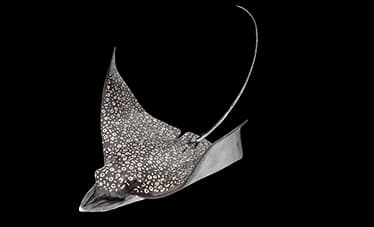
The spotted eagle ray is a cartilaginous fish of the eagle ray family, Aetobatidae. As traditionally defined it occurs globally in tropical waters of the Atlantic, Pacific and Indian Oceans, though some authorities now confine the name to the Atlantic and treat other populations as the ocellated eagle ray and Pacific white-spotted eagle ray. It is most often seen alone but occasionally moves in groups, and is ovoviviparous, with the female holding the eggs internally before releasing the young as small replicas of the adult.
Family
Aetobatidae
Avg Size
150-300 cm
Habitat
In its broad traditional sense the spotted eagle ray is found in tropical regions across the western Pacific, the Indian Ocean and the western Atlantic, favouring shallow coastal waters around coral reefs and bays down to depths of about 80 metres (262 ft). In the western Atlantic it occurs off the eastern United States, in the Gulf Stream and Caribbean and as far south as southern Brazil, while in the Indian Ocean it ranges from the Red Sea down to South Africa and eastward to the Andaman Sea.
Behaviour
Spotted eagle rays prefer water of 24 to 27 degrees C (75 to 81 degrees F), and their daily movements track the tides, with one study finding them most active at high tide. Uniquely among rays they root in the sand with their snouts, sending up a cloud that streams from their gills. They also perform two rapid up-and-down motions of the abdomen and pectoral fins, the pelvic thrust and the extreme pelvic thrust, the former usually done by a lone ray and repeated four or five times in quick succession.
Where & When to See It
Soma Bay Garden
Umm Gamar North
Woodhouse Reef
Gota Abu Ramada
Jackson Reef
Lighthouse
Shark's Bay
Banana Reef
Erg Abu Ramada
Far Garden
Habili Ali
Middle Garden
North Ras Abu Galum
Ras Ghozlani
Ras Zaatar
Shaab Abu Nugar
Shaab Sabina
Shaab Sataya
South Ras Abu Galum
The Islands
Thomas Reef
Turft El Shahed
Abu Hashish
Erg Sabina
Ras Ghamila
Shaab Eissa
Turtle Bay
Panorama Reef